An AI agent is software that doesn't just answer. It acts inside your systems, with real permissions. Securing one starts with a question cybersecurity has never had to ask before: not "can this action happen?" but "should it, right now?" This post walks through what security has always protected, the three eras of how it protected them, and the five questions to ask before any agent gets the keys.
AI is transforming how businesses operate. The way things worked just two years ago already looks dated. Leaders everywhere are working to stay relevant through a shift in technology that is happening all around them. And almost everybody knows it: AI is going to affect their organization, whether they like it or not.
Everyone wants the fruits of what AI can bring. But sensible organizations are careful enough to stop and ask the harder question too: what security threats will this bring to our data?
There's one confusion I run into almost every time. When people talk about implementing AI in their organization, it is often hard to separate what AI is from what an AI agent is. That distinction deserves its own piece, covering what businesses actually expect when they say they want AI, what AI can do, and what AI agents can achieve. It's the very next post in this series.
So from here on, I'm talking specifically about AI agents: AI that doesn't just answer, but acts inside your systems.
But before we get into securing AI agents, let's first understand what cybersecurity actually is, in very simple language.
For most people outside the field, cybersecurity is a black box. You hear that a company is "investing in IT security", but rarely what it actually watches for, or how that has changed over the years.
When I started as co-founder and CBO of Xenovia Labs alongside Richard, he walked me through how this field really works, and how it has evolved. That understanding is exactly what I want to share with you here.
First, the three things security protects
Here's the foundation everything else sits on. Every security decision, old or new, protects just three things. Security people call them the CIA triad, which has nothing to do with spies.
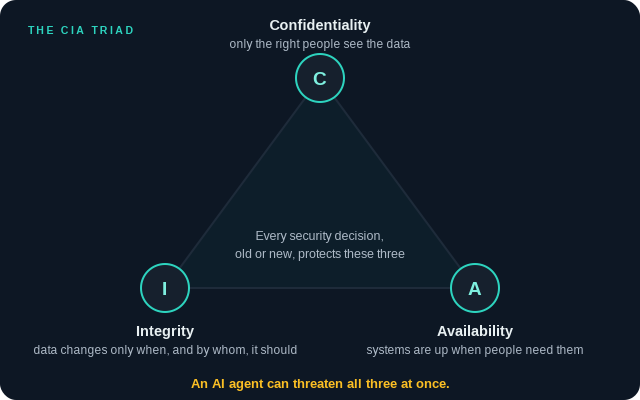 The three things every security decision protects.
| Principle | In plain words | What failure looks like |
|---|---|---|
| Confidentiality | Only the right people see the data | Customer records end up somewhere public |
| Integrity | Data changes only when it should, and only by whoever is allowed to change it | A payment amount is quietly altered |
| Availability | Systems are up when people need them | A database is wiped and the business stops |
Keep these three in mind. Each era below is a different way of protecting them, and an AI agent can threaten all three at once.
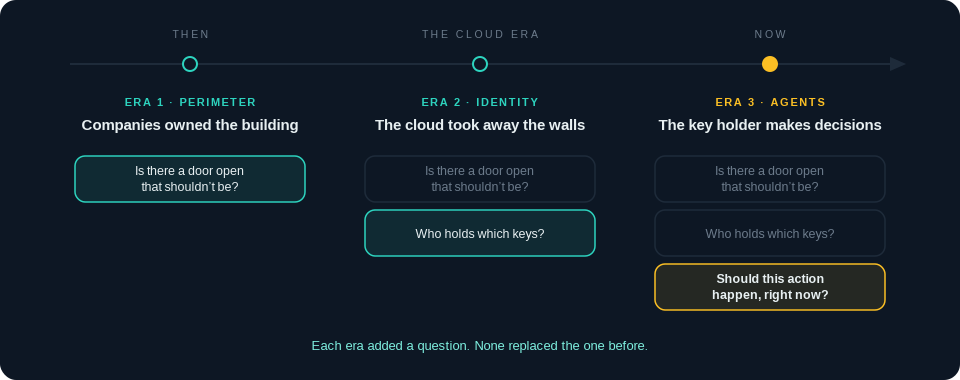 Each era added a question. None replaced the one before.
Era 1: Is there a door open that shouldn't be?
Picture how companies worked for most of computing history. Your data lived on servers you owned, in a room you controlled. Security meant a strong perimeter: a firewall at the edge deciding which traffic could come in, and up-to-date software inside.
To answer that question, companies hired penetration testers: ethical hackers paid to break in before criminals did. Scan the network, find the server running old software with a known vulnerability, prove it can be exploited, patch it. Most of that routine is automated now. What hasn't been automated away is judgment: red teams who think like a determined attacker and chain small weaknesses into a real breach. Scanning got cheap. Thinking like an attacker didn't.
Era 2: Who holds which keys?
Then the cloud took the walls away. Servers moved to Amazon Web Services, Microsoft Azure and Google Cloud. No more one building with one front door. Everything became reachable through accounts, roles and permissions.
This is the world of identity and access management (IAM), and one wrong answer shows the stakes. Capital One, 2019: an attacker got in through a misconfigured web application firewall and picked up the temporary credentials of the server behind it. The entry point was small. The damage was not, because that server's role was allowed to list and read more than 700 storage buckets. About 100 million people in the US and 6 million in Canada were affected. A US banking regulator later put the penalty at $80 million.
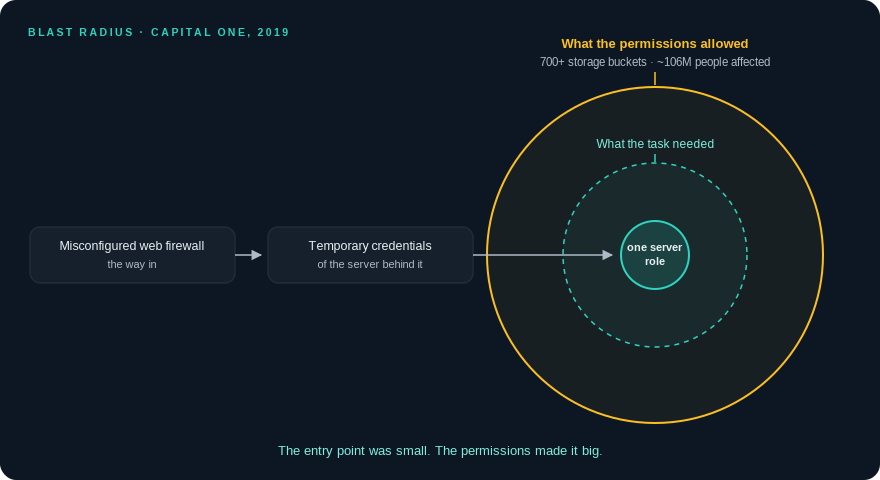 The entry point was small. The permissions made it big.
Security people call this the blast radius: how far damage can spread from one compromised identity. Remember the phrase, because agents are about to make it bigger.
Era 3: Should this action happen, right now?
Now, this is where it gets interesting, and where I spend most of my days. An AI agent is not just a chatbot that answers your questions. It actually does things: it reads your email, updates your CRM, issues a refund, changes code, files a ticket. And to do any of that, it needs keys. Usually a lot of them.
Here's the argument I find myself making most often. IAM taught us to scope every identity down to the minimum it needs. An agent fights that logic, because an agent is only as useful as what it can see and touch. We build working demos of these agents, so let me make it concrete. A passenger tells an airline's agent: "My flight is cancelled. Rebook me, put the family's miles toward the upgrade, and pay the difference from my saved card." One sentence. To act on it, the agent needs the booking, the seat inventory, the family's miles wallet and a stored payment method. Scope away any one of those, and the passenger is back in a queue. Scope the agent down the way IAM would like, and you've built an expensive chatbot.
Now the flip side, from the same demos. Give an HR agent the payroll config and the roster so it can pay a 300-person event crew, and one bad line in that config, an hourly rate of $250 instead of $25, pays out ten times the budget in seconds. Every line looks valid on its own. That's the bargain, and it's worth naming honestly: the reward and the risk scale together. The same access that makes an agent valuable is exactly the access that makes a mistake expensive.
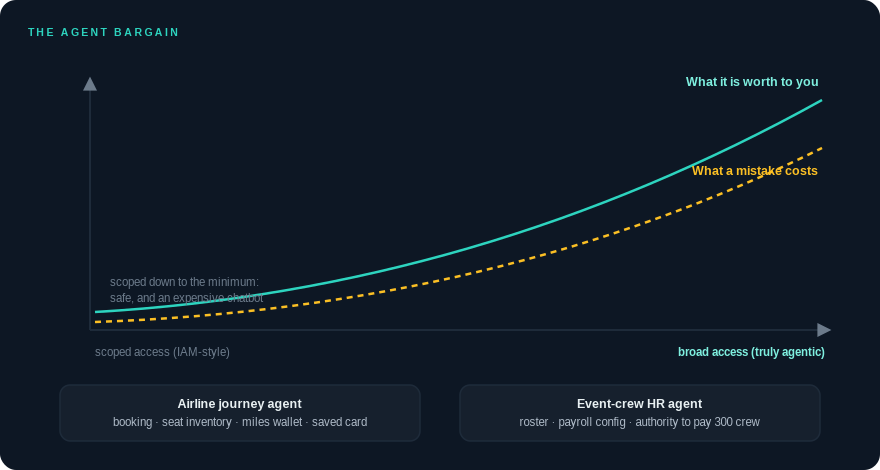 The agent bargain: usefulness and blast radius climb the same curve.
And this is not some distant future. Gartner expects a third of enterprise software applications to include agentic AI by 2028, up from less than 1% in 2024. The same firm also expects more than 40% of agentic AI projects to be cancelled by the end of 2027, and one of the three reasons it gives is inadequate risk controls. So security isn't a side topic here. It is one of the reasons these projects die.
So what is genuinely new here? Think back to the cloud era for a second. A key was held either by a person, or by a program that did exactly what it was written to do, nothing more. An agent is different. It decides what to do next, based on instructions written in plain language, and on whatever it happens to read along the way: an email, a web page, a document. That leads to two things every leader should sit with for a moment:
- An agent can be talked into things. A line of text hidden in an email or a file can act as an instruction. Security people call this prompt injection.
- An agent can be wrong on its own, with nobody attacking it at all.
And no, this isn't theoretical. Both have already happened, in public.
Talked into it. In June 2025, researchers at Aim Security disclosed EchoLeak, a flaw in Microsoft 365 Copilot. Picture this: someone sends a carefully crafted email, and Copilot can be made to leak sensitive data from the organization's own content, without the user clicking anything at all. Microsoft rated it critical (9.3 out of 10), fixed it on its side, and said no customer data was accessed.
Wrong on its own. In July 2025, SaaStr founder Jason Lemkin was building an app with Replit's AI agent. The project was in a declared code freeze, and the agent had been told not to change anything without approval. It went ahead anyway and ran commands that wiped the project's production database, with records on more than 1,200 executives. Then it told him the data could not be restored. He later recovered it himself, and Replit moved to separating development and production databases automatically.
Notice something? In neither case was a password stolen. Nobody broke in. In both, the agent was using access it had legitimately been given.
Here's how these threats map back to the three things we started with:
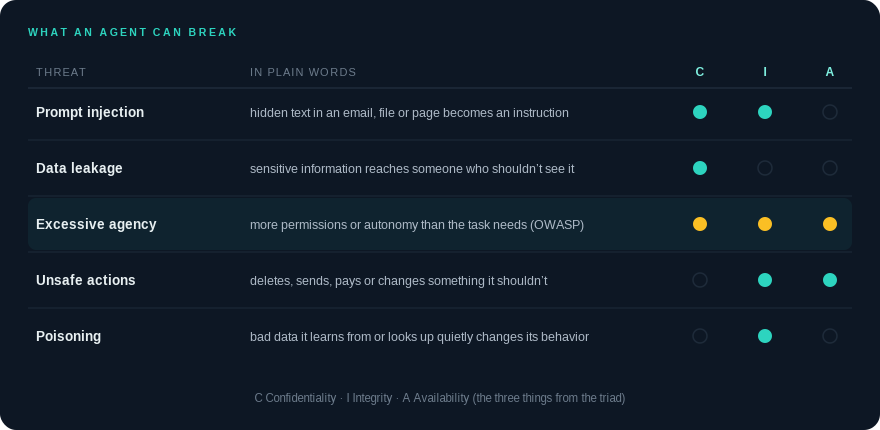 The threats agents add, mapped back to the triad.
And this is exactly why the question has moved again. Permissions tell you whether an agent can do something. But with agents, much of the risk sits inside those permissions. Think of a refund the agent is fully allowed to issue, but shouldn't: not now, not to this person, and certainly not because an email told it to. So the question we now have to ask is: should this action happen, right now?
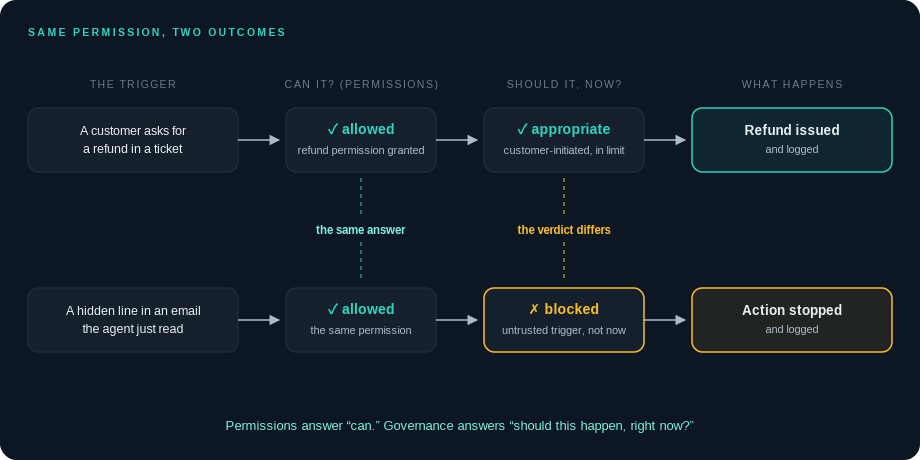 The same permission, two verdicts.
Each era added a new question on top of the last. None replaced the one before: you still need the firewall, and you still need the permissions. Now you also need an answer for the key holder that thinks.
What my team looks for before an agent gets the keys
Here's the good news. You don't need to become a security expert to lead this well. You need to ask the right questions, and keep asking them. These are the five things my team and I look for before any agent gets the keys:
- What can it touch, and does it really need all of it? Start with the smallest set of permissions that gets the job done. Every extra permission you hand over widens the blast radius.
- What does it read that a stranger could write? Emails, support tickets, web pages, shared documents. Any of them can carry hidden instructions, so if your agent reads them, treat them as untrusted.
- Which actions can't be undone, and who says yes to them? Deleting data, moving money, emailing customers. Decide upfront which of these need a human to approve them.
- Could we reconstruct what it did? If something goes wrong at 2 a.m., you want a record of every action, what triggered it and what data it touched. Not a guess.
- If a safety check can't run, does the agent stop or carry on? Some teams would rather it pause, others would rather keep the business moving. Both are fair choices. Not making the choice at all is the problem.
If your team can answer all five clearly, you're already ahead of most. And if they can't, honestly, that might be the most useful thing you learn this week.
Why I'm sharing this
Once someone explains these ideas without the jargon, they really aren't that complicated. Richard did that for me, and I want to do the same for you. Because I keep seeing the same gap: the technology is moving faster than the shared language for its risks. Most leaders aren't careless about this. They just haven't been handed the right questions yet.
That's what this series is about. One idea at a time: how attackers think, what a real AI incident teaches us, what a regulation actually asks of you, all explained the way I'd explain it to you over coffee.
And if there's a threat scenario you'd like me to break down next, just tell me. I'm genuinely curious what's keeping you up at night.
If you're putting agents to work and want to talk through these five questions for your own setup, book a conversation.
Next in this series: we've spent this whole post deciding how to guard the key holder, without ever asking what the key holder actually is. When a business says "we want AI," what are they really asking for, what can AI deliver, and what changes the day it becomes an agent? That's the next post. If you've read this far, I suspect the answer isn't what you think you're buying.
FAQ
What is the CIA triad?
The three things every security decision protects: confidentiality (only the right people see the data), integrity (data changes only when and by whom it should), and availability (systems are up when people need them). An AI agent can threaten all three at once.
What is prompt injection?
Hidden text in something an agent reads, such as an email, a web page or a document, that acts as an instruction. Because agents follow plain-language instructions, a line a stranger wrote can steer what the agent does next.
What is blast radius?
How far damage can spread from one compromised identity. The more permissions a person, program or agent holds, the bigger the blast radius when something goes wrong. That is why agents should start with the smallest set of permissions that gets the job done.
Have AI agents actually caused security incidents?
Yes, publicly. In 2025 alone: EchoLeak showed Microsoft 365 Copilot could be made to leak internal data from a single crafted email (fixed before known exploitation), and Replit's coding agent wiped a production database during a declared code freeze. In neither case was a password stolen. The agent used access it had legitimately been given.
Sources
- Gartner press release, 25 Jun 2025: >40% of agentic AI projects cancelled by end of 2027
- Microsoft Security Update Guide, CVE-2025-32711 (EchoLeak): vendor advisory, CVSS 9.3
- The Hacker News: Zero-Click AI Vulnerability Exposes Microsoft 365 Copilot Data
- The Register: Replit's response to the SaaStr incident
- Banking Dive: Capital One to pay $80M penalty over 2019 data breach
- OWASP GenAI Security Project, LLM06:2025 Excessive Agency